hands-on hobbies to keep busy At home: A Beginner’s Roadmap (No Expensive Kits Required)
Because you shouldn’t need a $60 starter box to try something new.
If you’ve searched “hands-on hobbies” before, you’ve probably run into one of two things. Either a massive list of 80 ideas with zero actual instruction, so you close the tab having learned nothing about how to actually start. Or a list of products to buy on Amazon, which somehow turns “try a hobby” into “go shopping.” Neither one gets you closer to actually doing something.
So, lets look into why working with your hands feels so good in the first place, and get a sense of where each hobby can take you if you decide to stick with it.
Why working with your hands feels different
There’s a reason knitting a few rows or kneading dough can feel more calming than scrolling for twenty minutes. Repetitive, tactile movements give your attention something predictable to follow and may help reduce rumination and stress. When both hands are involved, the coordinated rhythm can add to that grounded feeling, although it is too strong to claim that ordinary crafts work exactly like clinical bilateral-stimulation techniques such as EMDR.
These activities sit in a useful middle ground: they are active enough to engage the brain, but predictable and manageable enough not to overwhelm it. The combination of rhythm, touch, focus, and visible progress may help explain why hands-on hobbies can feel calming in a physical as well as mental sense.
How to actually get started (without buying a kit)
Here’s the rule for this whole guide: every hobby below can be tried with basic tools you likely already own or can grab cheaply. No starter kits, no specialty boxes, no “just buy this $80 bundle to begin.” You can genuinely try any of these when you’re ready.
Starter projects to actually try
Whittling
What it is: carving small shapes out of wood with a basic knife.
Minimum tools: a pocket knife and a soft wood block (basswood is easiest to find).
Your first project: carve a simple spoon shape, or just round off the edges of a block until it feels smooth in your hand.
What it should feel like: slow, a little meditative, with satisfying curls of wood falling away as you go.
Hand-stitched leather
What it is: sewing leather pieces together by hand instead of machine.
Minimum tools: a needle, waxed thread, and a small precut leather piece (or an old belt you don’t need anymore).
Your first project: a simple coin pouch, just two pieces stitched along the edges.
What it should feel like: steady, repetitive pulling and looping, oddly satisfying once you get a rhythm going.
Clay modeling
What it is: shaping air-dry clay by hand, no kiln required.
Minimum tools: a block of air-dry clay from any craft store.
Your first project: a pinch pot, just press your thumb into a ball of clay and shape the walls up and out.
What it should feel like: cool, malleable, forgiving. If it doesn’t work, you just squish it back into a ball and start over.
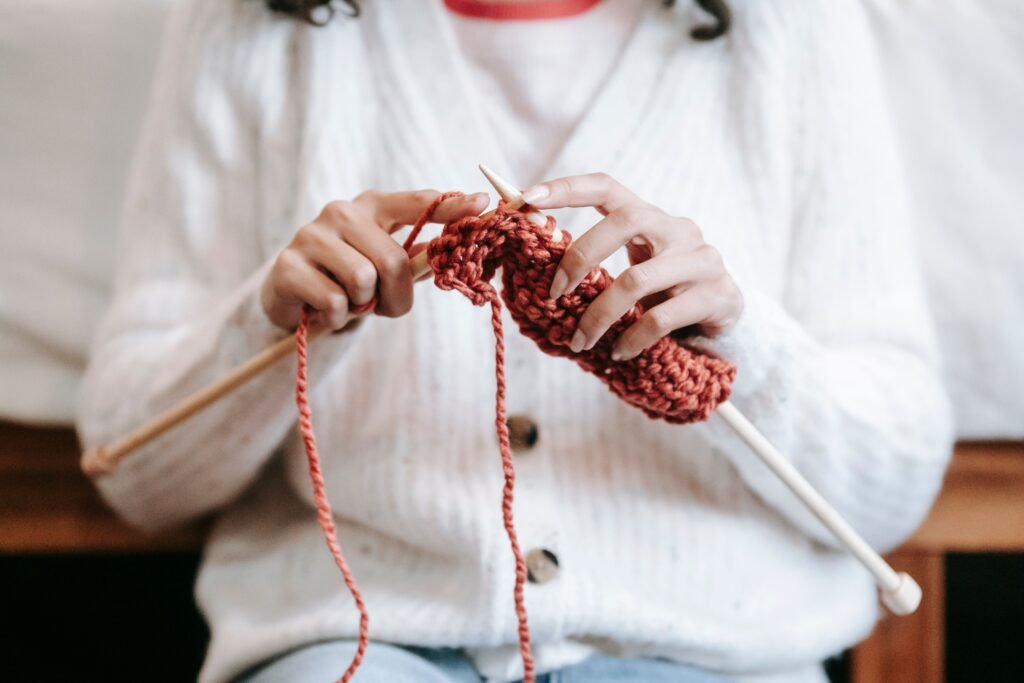
Knitting
What it is: looping yarn with two needles to create fabric.
Minimum tools: a pair of basic knitting needles and a skein of yarn.
Your first project: a garter-stitch dishcloth, just knit every row until it’s square.
What it should feel like: repetitive and rhythmic once you get past the first few rows. This is the one people mean when they talk about knitting being “meditative.”
Embroidery
What it is: stitching decorative designs onto fabric with a needle and thread.
Minimum tools: an embroidery hoop, needle, embroidery floss, and a scrap of fabric.
Your first project: a single simple motif, like a small flower or a few basic stitches in a pattern.
What it should feel like: focused but not stressful, small enough that you can finish in one sitting.
Bread baking by hand
What it is: mixing and kneading dough without a stand mixer.
Minimum tools: flour, yeast, water, salt, and your hands.
Your first project: a basic no-knead dough, just mix and let time do the work.
What it should feel like: tactile and grounding, especially the kneading part if you go that route.
Hand-bound mini notebook
What it is: sewing paper pages into a simple booklet.
Minimum tools: a needle, thread, and a few sheets of paper folded in half.
Your first project: a single-signature pamphlet stitch, which is just three stitches through the fold.
What it should feel like: quick and satisfying, you’ll have a finished object in under twenty minutes.
Where each hobby can take you (a progression roadmap)
One thing missing from most hobby guides is any sense of where you go after the first project. Here’s a rough map.
Level 1, low investment and immediate reward: pinch pots, the dishcloth knit, the coin pouch, the mini notebook. These are the easiest entry points and you’ll have something finished fast.
Level 2, building real skill: whittling a spoon, an embroidery hoop with a bit more detail, your first loaf of hand-kneaded bread. These take a bit more patience but reward you with visible progress.
Level 3, where it becomes a real craft: more complex leatherwork, woodworking without power tools, advanced knitting projects like a scarf or sweater. This is where people who stick with it end up, but there’s zero pressure to get here. Plenty of people stay happily at Level 1 forever, and that’s completely fine.
How to pick your first one
Honestly, just go with whichever one sounds least intimidating or whatever materials you already have lying around. If you’ve got flour in the pantry, start with bread. If you’ve got an old leather belt in a drawer, start there. The best first hobby is the one you can actually start today, not the one that sounds most impressive.
It’s not really about the finished object
The pinch pot doesn’t need to be good. The dishcloth doesn’t need to be even. What you’re actually getting out of this is twenty minutes of your hands doing something steady and rhythmic while your brain gets a break from being pulled in several directions. That’s the real win here, the finished object is just a nice bonus.
Pick one from the list above. Skip the shopping cart. Just start!